The Insider - October 2026
Leadership instincts, the deep tiredness, and the trust economy
Leadership instincts, the deep tiredness, and the trust economy

Hi everyone,
Welcome to the October edition of the Insider. Do you know someone who would enjoy the Insider? Forward this email to them, and they can subscribe here.
James Daunt is leading a stunning turnaround at Barnes & Noble. The company has opened 120 new stores in the last two years and has plans to go public. Decades ago, Daunt started with just one independent bookstore in London, Daunt Books. His obsession with bookselling at the smallest scale has made him the perfect fit to turn around America’s largest brick-and-mortar bookseller. Underneath Barnes & Noble’s comeback is a long history of Daunt using his first bookstore as a place to perfect his craft and form strong opinions about bookselling.
He applied many of those lessons at Barnes & Noble, but mostly he decentralized power. He gave local booksellers the autonomy and creativity to sell books they knew their customers would buy. In a store in Cheyenne, Wyoming, the selection reflects the local politics and interests. In Brooklyn, the books on display are different.
No small part of Daunt’s success comes from his obsession with the customer-facing retail experience of bookselling. Decades in his own store gave him the confidence to make bold moves at Barnes & Noble, decisions that other leaders, who had not lived and breathed bookselling, were either too afraid to make or unaware of entirely. There are counterexamples, like Asha Sharma, who is transforming Xbox without being an industry veteran or gamer herself. But leadership is as much about having the confidence to trust your instincts as it is about anything else, and that confidence often requires a commitment to apprenticing in the craft.
I’ve found the best way to write this newsletter is to trick myself into thinking I’m having a conversation with just one person. If I remind myself that I’m actually writing to thousands of people, then suddenly my writing changes and the quality drops.
Something happens to us when we think we have a megaphone. We become caricatures of ourselves: stiff or exaggerated or one-dimensional—lured in by the internet’s extraordinary scale and beguiling algorithms.
So it’s no surprise that my favorite parts of the internet are in its smallest spaces and forgotten corners: group chats among friends, Slack groups full of dads, and small newsletters written with care and pluck by humans toiling over the right words. Such spaces are rich in context and punctuated with moments of delight.
Y Combinator co-founder Paul Graham makes a related point: it’s better to have a hundred people love you than one million people who sort of like you. I think that’s probably true: instead of designing for scale, it might be wise to build for the smallest, most obsessed group of superfans. The core nucleus of something beloved has a greater chance of going somewhere than a mediocre product tolerated by the masses.
It makes me think that we are moving into the era of the small internet, where more of everything—commerce, relationships, ideas—will happen in small spaces with trust as the currency. I’ve started to think of this as the trust economy.
In the trust economy, our attention follows the object of our trust. The products and services that gain traction and grow are those that are so loved that people can’t help but share them. They grow by way of group chats, warm intros, friends of friends, and statements like, “I have the perfect person you should talk to.”
There will still be a role for the grand spaces—the digital ballrooms of Trumpian proportions—where virality, showmanship, and endless scroll dominate. But I don’t think we’ll spend as much time there as we have in the last few decades. Yes, we’ll rely on the internet for the two-day shipping of socks and books (the commodity economy), and we’ll still log in to consume vertical videos and serialized shows (the attention economy), but the internet will continue to shrink into micro-internets and micro-economies where trust is the social infrastructure binding each space together.
This is, after all, how it’s always been. We have always sought the most real and trust-dense spaces we can find. From someone referring an electrician to their neighbor to a sales executive selling a 6-figure enterprise software contract, everything is downstream of trust.
I believe we’ll see more people and businesses building in the trust economy. Content creators will realize that saying something is not the same as being heard. Businesses will realize just how frigidly cold and ineffectual a cold email is. Small businesses will question whether they need to aggressively grow, instead plumbing the depths of their most trusted relationships and networks.
We’re entering a world of big opportunity in small spaces. When we can publish something and it can be read instantly anywhere in the world, the impediment to success isn’t the ability to send and distribute. When we can build software with AI in a matter of minutes, the constraint (for some businesses) isn’t the ability to build. The rate-limiter of a person’s future potential or a business’s future success is found in the rich web of trust in which it operates. Reputation is a moat. Follow-through is an unfair advantage. The ability to be remembered and recommended is the most valuable distribution channel that has ever existed.
In the coming months, I’ll be exploring the trust economy in more detail: the people and businesses who are succeeding in it, the playbooks they’re using, and how a future that seems destined for unrecognizable disruption might look like a return to what’s always been true.
Many years ago I interviewed a successful entrepreneur who was manufacturing solar batteries. The thing with batteries, he told me, is that if they fully lose their charge too many times, they’ll never be able to charge all the way back up to 100%. He explained the electrochemical phenomenon, and then, with a deep tiredness in his eyes, said that he, too, was like his batteries: so burned out that he worried he could never fully recharge.
I have thought about him often over the years and wondered if he was right. In that time, I’ve begun to notice that creeping tiredness in my own eyes. But I’ve chosen to see it not as some inability to get back to 100%, but rather as an optical imprint of resilience, an odometer measuring distance traveled. Sometimes, when I see it in someone else, we exchange an unspoken salute: so you’ve been through it, too?
But what I’ve found most common among second- or third-time entrepreneurs is a glimmer in their eye alongside the tiredness. They’ve still got charge left, still harboring some harebrained vision or secret dream.
I have stared into the mirror and seen that flickering thing in my own eyes. I suppose what is different for those of us who carry our ambition alongside our tiredness is the shape of our dreams: they no longer dance and bloom above our heads in full resplendence, nor do they live for years safely cocooned from reality and unpricked by life’s unrelenting pressure. Instead, that tiredness produces something even more powerful: the capacity to take a dream and take it very seriously.
Perhaps it’s self-centered of me, but my favorite part about extended travel is witnessing how a faraway place changes me. In New York, I discovered a side of myself who wanted to be great and put myself into the thrum and syncopation of a city where greatness might be thrust upon me. In Mexico City, I discovered a side of myself who wanted to be immersed in the senses—to experience every flavor in a street taco, every note in a glass of mezcal, every intonation in a burst of Spanish in the market.
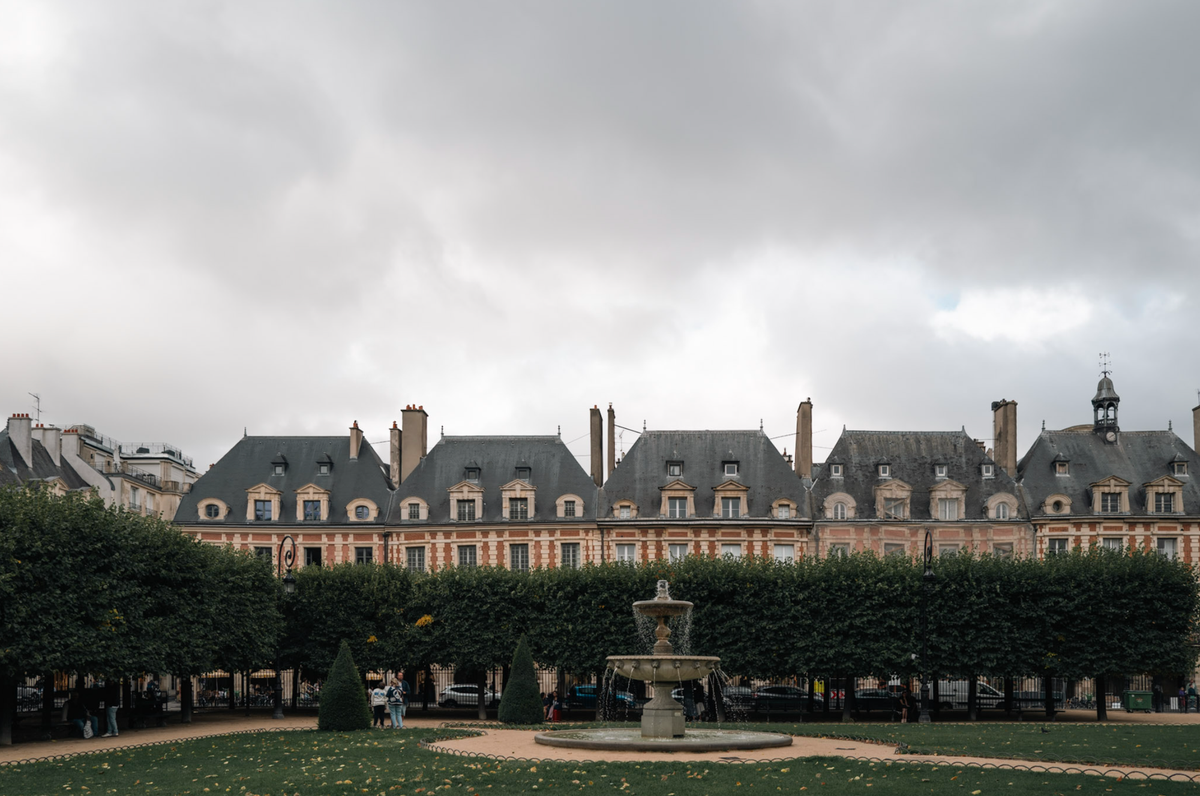
So I was interested to see who would come forth when Lisa, Emilio, and I spent six weeks in France and Italy this fall. Emilio turned one in the South of France. In Italy, we watched him connect his first step to his second and then his third—until one day in Sicily he walked all the way across the room of our flat before collapsing into Lisa’s arms, his smile as big as a pizza.
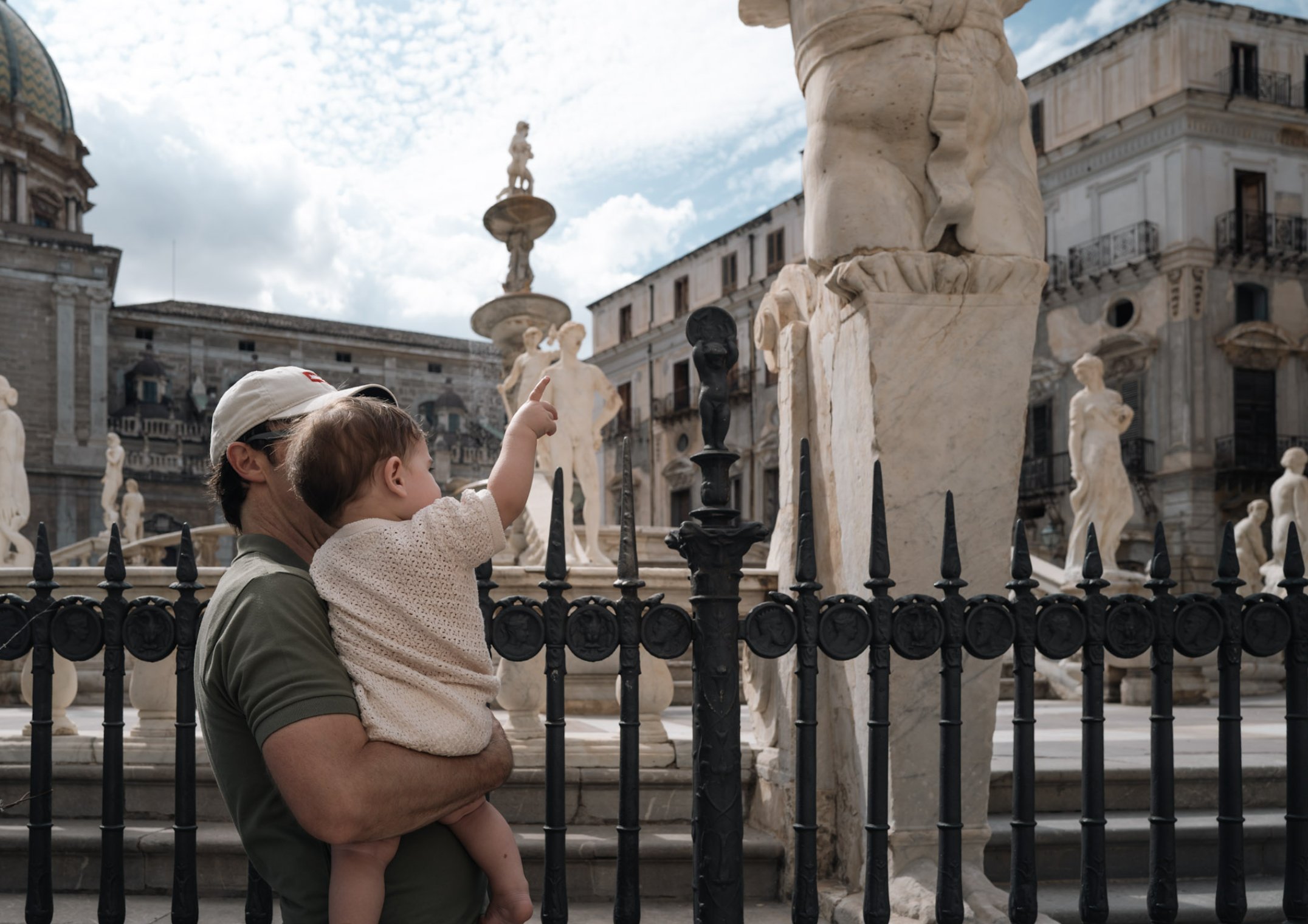
I spent many mornings walking quiet cobbled streets with his tiny hand in mine. One day, we came upon a statue that was sculpted into the stone of a building, high above our heads. Perhaps it was an old priest or an important patron of the arts. Emilio looked up and pointed at it with a chubby finger and then looked back at me and smiled. “Look at that person way up there, Dad,” he seemed to say.
A few weeks later, we stepped into the Sistine Chapel. I looked down at Emilio, and he was calmly staring upward, his finger pointing at Michelangelo’s masterpiece. In every depiction of the ancients, the saints, the cherubs, the deities, he recognized a person.
Our time in Europe started to make me more aware of the winding, invisible threads through generations and centuries, more connected to my own family, who emigrated from Italy a century ago, and more attuned to the grand historical arc that Emilio is taking forward.
Perhaps I was experiencing nothing more than the obvious “epiphany” of Americans who travel to Europe and say, “Wow, everything is so old.” But for me, it was a new side of myself: when our tiny son, who stumbled his way along those ancient, uneven cobblestones, would pause and gaze and point at a world so old and continuous and interconnected, I, too, could see something I had never seen before. “Look, Dad!”
~~~
Home now,
Banks